

Mohamed Elhefnawy, Kyoung-Hun Kim, and Wang-Sang Lee
Journal of Electromagnetic Waves and Applications, Vol.39, No.3, pp.229~250
A mathematical model and characteristic mode analysis explain the bandwidth of an ACPW microstrip antenna of quarter-wave line segments, which works in four bands up to 11 GHz.
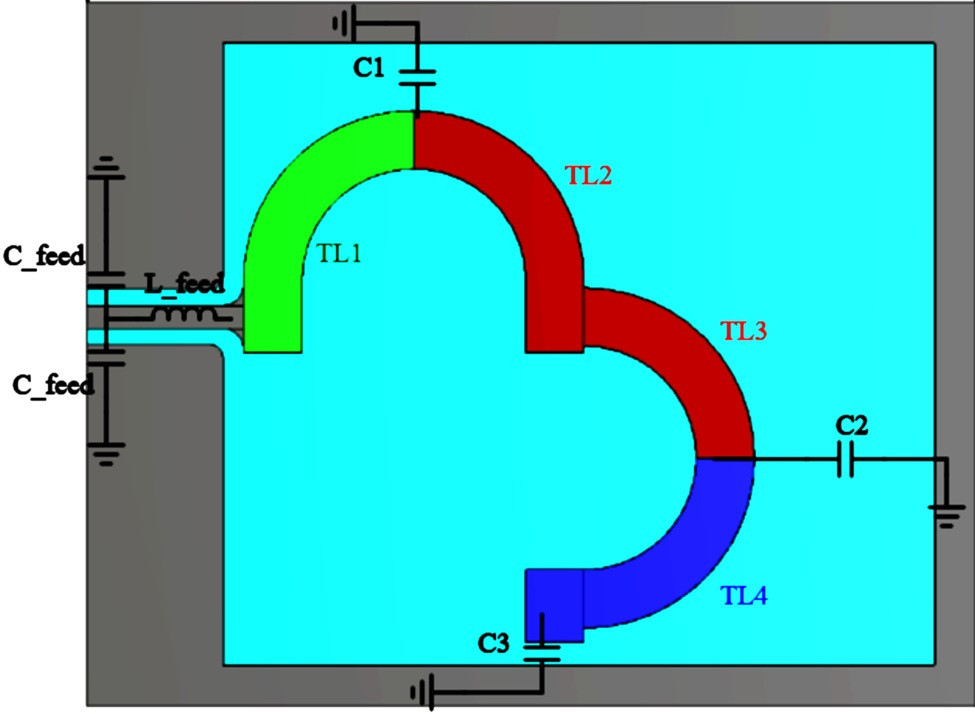
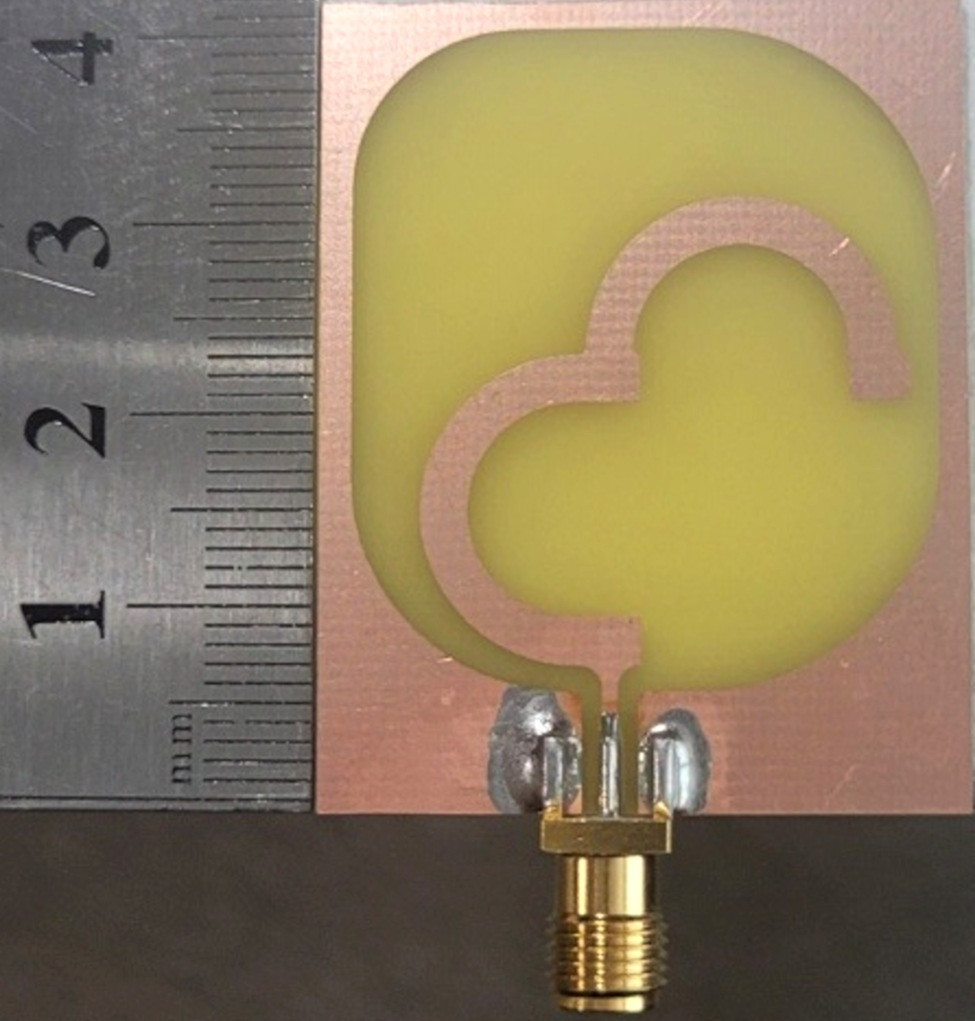
This paper introduces an innovative antenna configuration that incorporates multiple quarter-wavelength transmission line segments. Additionally, it presents a mathematical framework for modeling the proposed antenna and deriving an expression for its input impedance, thereby investigating the effects of various parameters on its bandwidth. The design of the proposed antenna utilizes an asymmetric coplanar waveguide (ACPW) due to its ease of implementation without the need for vias. Furthermore, the implementation of ACPW results in parasitic coplanar capacitances, which are used to tune the resonance modes of the proposed antenna, thereby extending its bandwidth. Curved corners are incorporated into the proposed antenna, and characteristic mode analysis (CMA) is used to investigate the effect of these curved corners on the significant modes and radiation pattern. The proposed antenna has electrical dimensions of 0.3λ0×0.25λ0×0.007λ0 at a frequency of 2.29 GHz. The antenna prototype has been fabricated and measured. The measured −10 dB fractional bandwidths are 48.1% (from 2.29 to 3.74 GHz), 30.5% (from 5.19 to 7.06 GHz), 7.1% (from 8.33 to 8.94 GHz), and 13.9% (from 9.74 to 11.19 GHz). Moreover, the measured maximum realized gain is 7.05 dBi. These features make the proposed antenna an attractive candidate for various wireless communication systems.
사분파장 선로 조각으로 만든 ACPW 마이크로스트립 안테나의 입력 임피던스를 수식으로 모델링하고 특성모드 해석으로 대역폭을 분석해, 11 GHz까지 네 대역에서 동작시킨다.
This paper introduces an innovative antenna configuration that incorporates multiple quarter-wavelength transmission line segments. Additionally, it presents a mathematical framework for modeling the proposed antenna and deriving an expression for its input impedance, thereby investigating the effects of various parameters on its bandwidth. The design of the proposed antenna utilizes an asymmetric coplanar waveguide (ACPW) due to its ease of implementation without the need for vias. Furthermore, the implementation of ACPW results in parasitic coplanar capacitances, which are used to tune the resonance modes of the proposed antenna, thereby extending its bandwidth. Curved corners are incorporated into the proposed antenna, and characteristic mode analysis (CMA) is used to investigate the effect of these curved corners on the significant modes and radiation pattern. The proposed antenna has electrical dimensions of 0.3λ0×0.25λ0×0.007λ0 at a frequency of 2.29 GHz. The antenna prototype has been fabricated and measured. The measured −10 dB fractional bandwidths are 48.1% (from 2.29 to 3.74 GHz), 30.5% (from 5.19 to 7.06 GHz), 7.1% (from 8.33 to 8.94 GHz), and 13.9% (from 9.74 to 11.19 GHz). Moreover, the measured maximum realized gain is 7.05 dBi. These features make the proposed antenna an attractive candidate for various wireless communication systems.
The abstract is from the published paper (doi:10.1080/09205071.2024.2440746).초록은 출판된 논문(doi:10.1080/09205071.2024.2440746)에서 옮겼습니다.