

Min-Seong Kim, Dong-Hwan Park, Mohamed Elhefnawy, and Wang-Sang Lee
IEEE Access, Vol.13, pp. 43249-43258
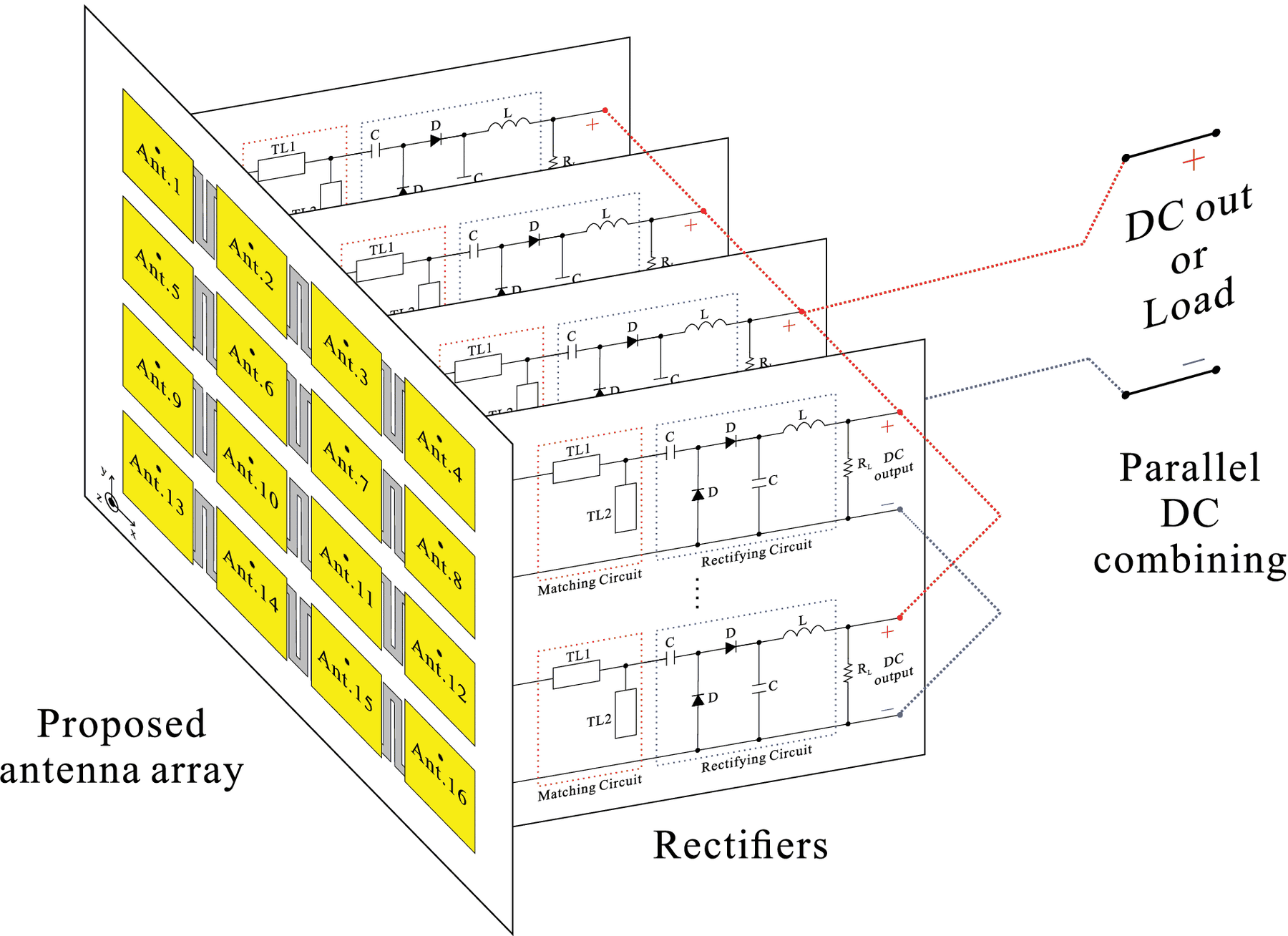
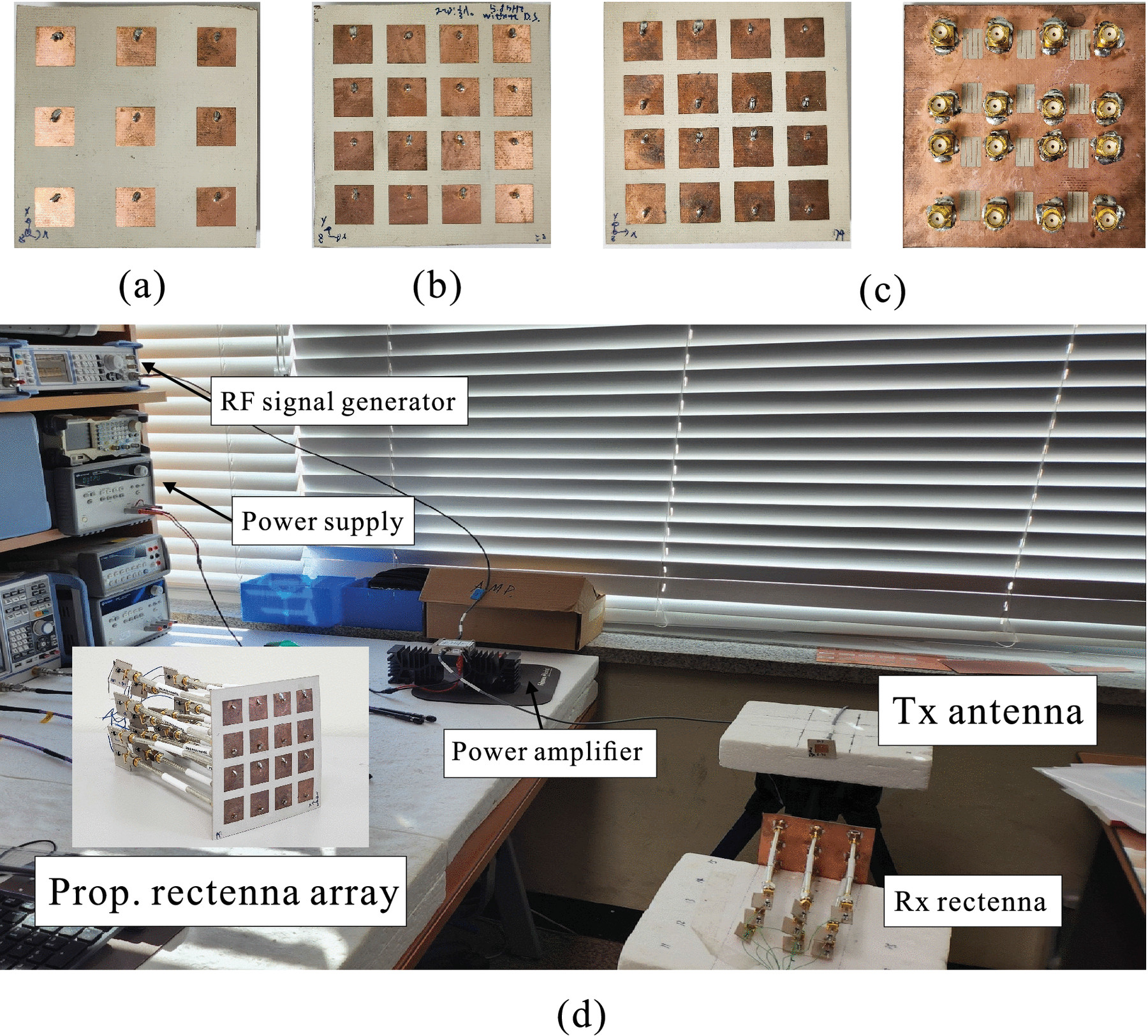
A 4×4 rectenna array at λ0/3 spacing with meander-line DGS decoupling slots raises received power at 5.8 GHz when the transmitter's polarization does not match.
In this paper, a rectenna array system using decoupling slots with a defected ground structure (DGS) is proposed to improve received power in wireless power transfer (WPT) applications. The proposed rectenna array features a 4 × 4 configuration with an antenna spacing of λ0/3 and introduces decoupling slots based on a meander line DGS structure between the H-plane arrays. The proposed rectenna array operates at 5.8 GHz and has dimensions of 78 × 78 × 0.76 mm3. The rectenna array achieves miniaturization, enhanced gain, and the ability to receive power regardless of the antenna polarization, through the high isolation formed by the decoupling slots. For performance validation, the operating principle of the proposed rectenna array system was theoretically analyzed and simulated. Additionally, the received power was measured based on the polarization of the transmitting antenna, and the results were compared with a conventional rectenna array and a proposed rectenna array without decoupling slots, both with the same area. The measurements show that the rectenna array with decoupling slots improves the power reception in environments with polarization mismatch, compared to the conventional rectenna arrays.
미앤더 결함접지 디커플링 슬롯을 넣어 λ0/3 간격으로 촘촘히 배치한 5.8 GHz 4×4 렉테나 배열로, 편파가 맞지 않아도 수신 전력을 높인다.
In this paper, a rectenna array system using decoupling slots with a defected ground structure (DGS) is proposed to improve received power in wireless power transfer (WPT) applications. The proposed rectenna array features a 4 × 4 configuration with an antenna spacing of λ0/3 and introduces decoupling slots based on a meander line DGS structure between the H-plane arrays. The proposed rectenna array operates at 5.8 GHz and has dimensions of 78 × 78 × 0.76 mm3. The rectenna array achieves miniaturization, enhanced gain, and the ability to receive power regardless of the antenna polarization, through the high isolation formed by the decoupling slots. For performance validation, the operating principle of the proposed rectenna array system was theoretically analyzed and simulated. Additionally, the received power was measured based on the polarization of the transmitting antenna, and the results were compared with a conventional rectenna array and a proposed rectenna array without decoupling slots, both with the same area. The measurements show that the rectenna array with decoupling slots improves the power reception in environments with polarization mismatch, compared to the conventional rectenna arrays.
The abstract is reproduced from the published paper (doi:10.1109/access.2025.3548974) under its CC BY 4.0 licence.초록은 출판된 논문(doi:10.1109/access.2025.3548974)에서 CC BY 4.0 라이선스에 따라 옮겼습니다.