
Tae-Hyeon Kim, Mohamed Elhefnawy, Kyoung-Hun Kim, and Wang-Sang Lee
IEEE Access, Vol.13, pp. 34070-34080
Two dual-CP stacked bow-tie Yagi-Uda arrays at 2.45 GHz are compared; the one with a complementary slotted director widens the axial-ratio bandwidth to 19.6% for IoT.
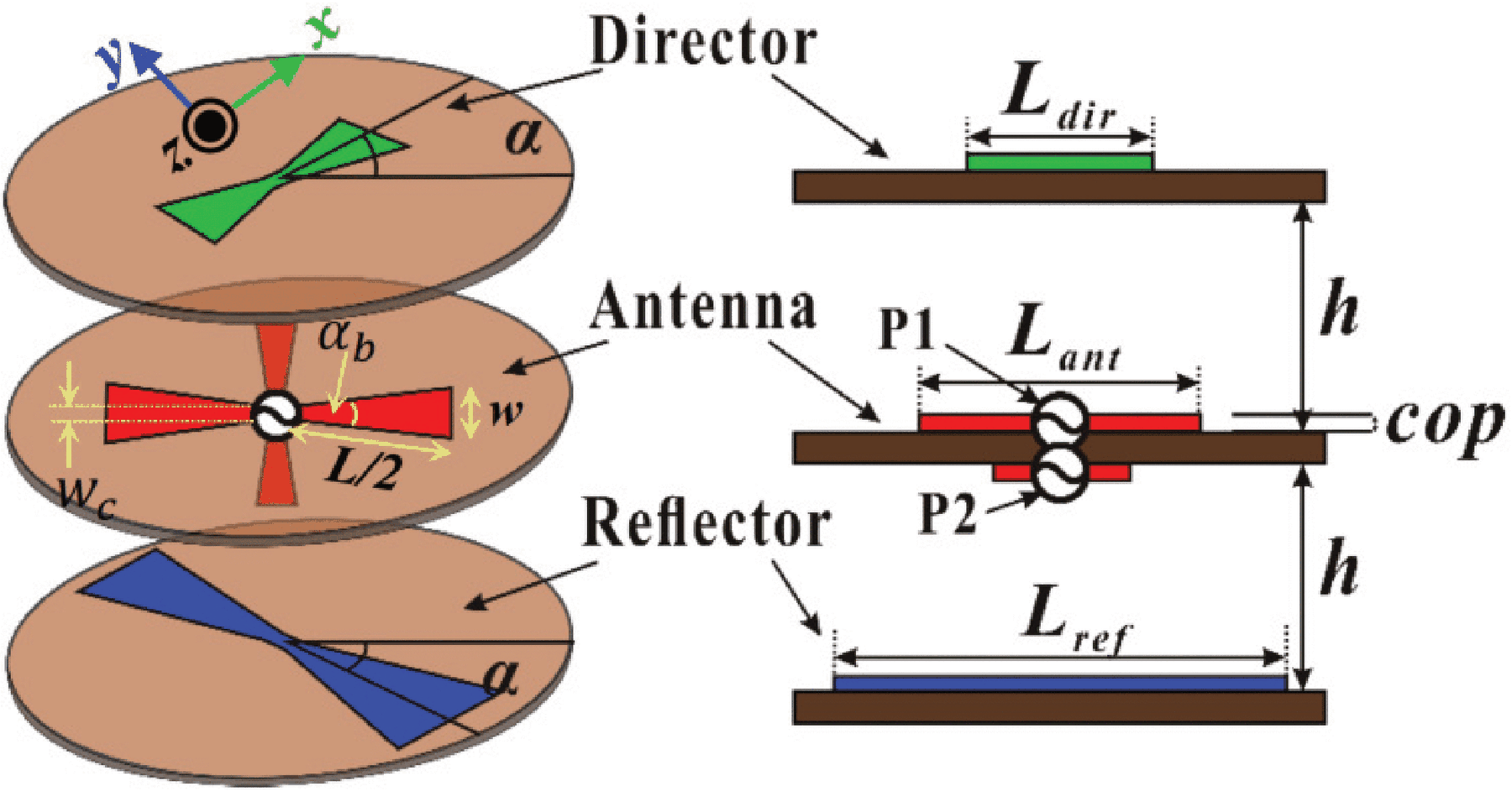
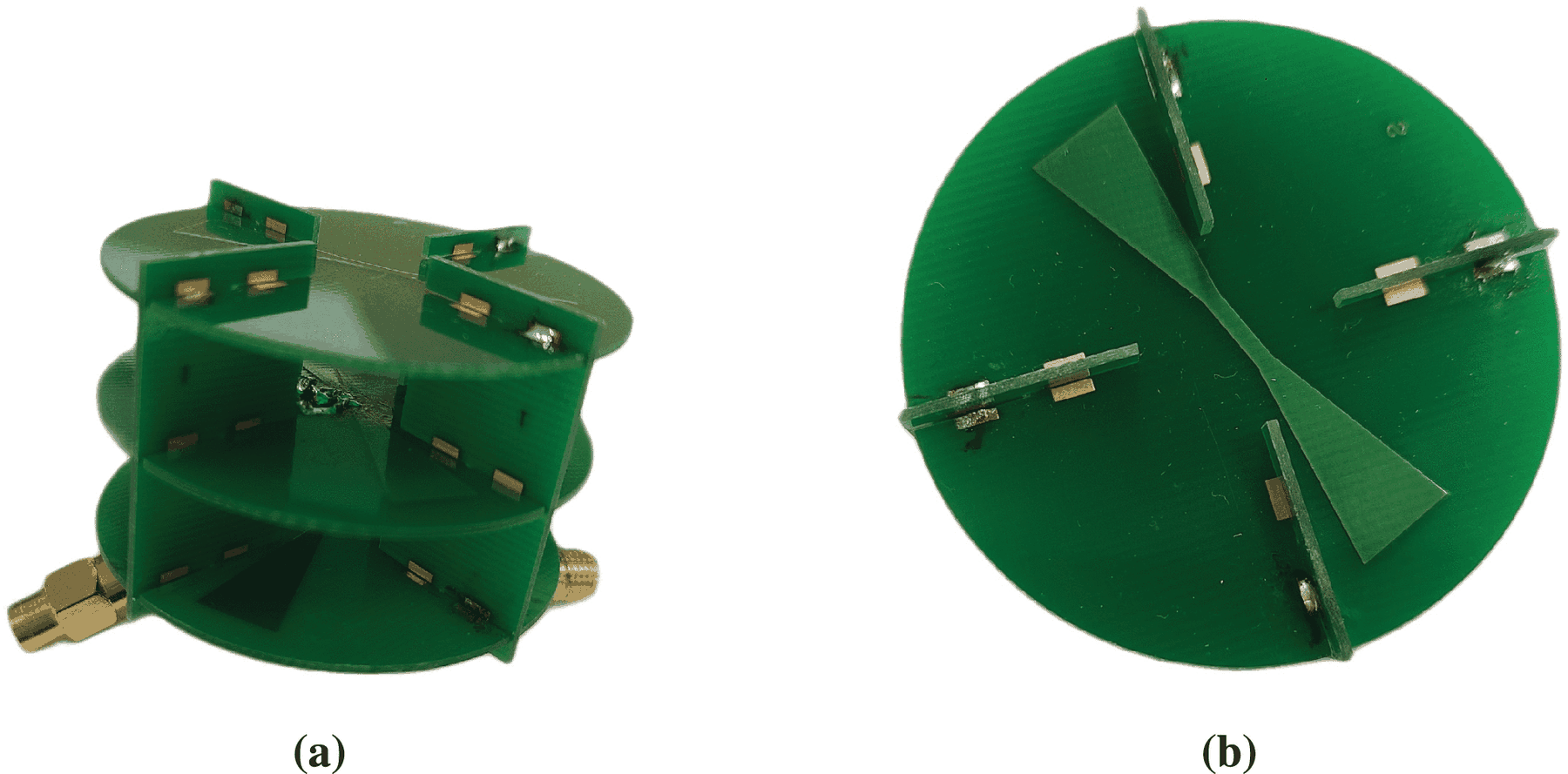
This paper presents the design and analysis of two dual circularly polarized stacked Yagi-Uda antenna arrays, referred to as Type A and Type B. The proposed Type A Yagi-Uda antenna array consists of four printed bow-tie-shaped elements arranged at different angles: a director, a reflector, and two orthogonal driven elements. The driven elements are connected to coaxial cables via LC baluns. The Type B configuration introduces a complementary slotted bow-tie director element in place of the printed one, while the driven and reflector elements remain unchanged. Exciting the upper driven element generates right-hand circular polarization (RHCP), whereas left-hand circular polarization (LHCP) is achieved when the lower driven element is excited. Both proposed antenna arrays share the same dimensions of 0.39λ0 × 0.39λ0 × 0.27λ0, where λ0 represents the free-space wavelength at the operating frequency of 2.45 GHz. Measured results confirm that Type B outperforms Type A in several aspects. The Type B antenna array achieves a fractional impedance bandwidth of 8%, a 3-dB axial ratio (AR) bandwidth of 19.6%, and a peak gain of 4.49 dBic. In comparison, Type A exhibits a fractional impedance bandwidth of 2.45%, a 3-dB axial ratio bandwidth of 2.45%, and a peak gain of 3.5 dBic. These findings highlight the effectiveness of the complementary slotted bow-tie director in enhancing antenna performance, making Type B a promising candidate for Internet of Things (IoT) applications.
2.45 GHz 이중 원편파 보타이 적층 야기-우다 배열 두 가지를 비교하고, 상보 슬롯 도파기를 쓴 쪽이 축비 대역폭을 19.6%로 넓혀 IoT에 적합함을 보인다.
This paper presents the design and analysis of two dual circularly polarized stacked Yagi-Uda antenna arrays, referred to as Type A and Type B. The proposed Type A Yagi-Uda antenna array consists of four printed bow-tie-shaped elements arranged at different angles: a director, a reflector, and two orthogonal driven elements. The driven elements are connected to coaxial cables via LC baluns. The Type B configuration introduces a complementary slotted bow-tie director element in place of the printed one, while the driven and reflector elements remain unchanged. Exciting the upper driven element generates right-hand circular polarization (RHCP), whereas left-hand circular polarization (LHCP) is achieved when the lower driven element is excited. Both proposed antenna arrays share the same dimensions of 0.39λ0 × 0.39λ0 × 0.27λ0, where λ0 represents the free-space wavelength at the operating frequency of 2.45 GHz. Measured results confirm that Type B outperforms Type A in several aspects. The Type B antenna array achieves a fractional impedance bandwidth of 8%, a 3-dB axial ratio (AR) bandwidth of 19.6%, and a peak gain of 4.49 dBic. In comparison, Type A exhibits a fractional impedance bandwidth of 2.45%, a 3-dB axial ratio bandwidth of 2.45%, and a peak gain of 3.5 dBic. These findings highlight the effectiveness of the complementary slotted bow-tie director in enhancing antenna performance, making Type B a promising candidate for Internet of Things (IoT) applications.
The abstract is reproduced from the published paper (doi:10.1109/access.2025.3543909) under its CC BY 4.0 licence.초록은 출판된 논문(doi:10.1109/access.2025.3543909)에서 CC BY 4.0 라이선스에 따라 옮겼습니다.