

Mohamed Elhefnawy, Kyoung-Hun Kim, and Wang-Sang Lee
IEEE Access, Vol.13, pp. 161026-161037
A single-layer K/Ka-band reflectarray using variable rotation and a dual-CP corrugated horn feed gives a very narrow beam with 28.6 dBic peak gain and 40.5% aperture efficiency.
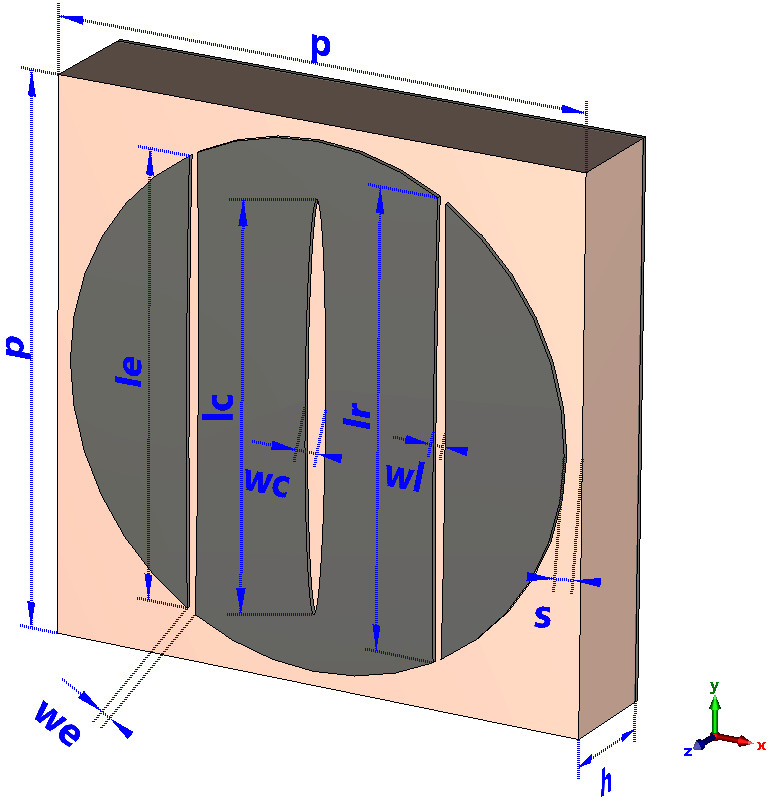
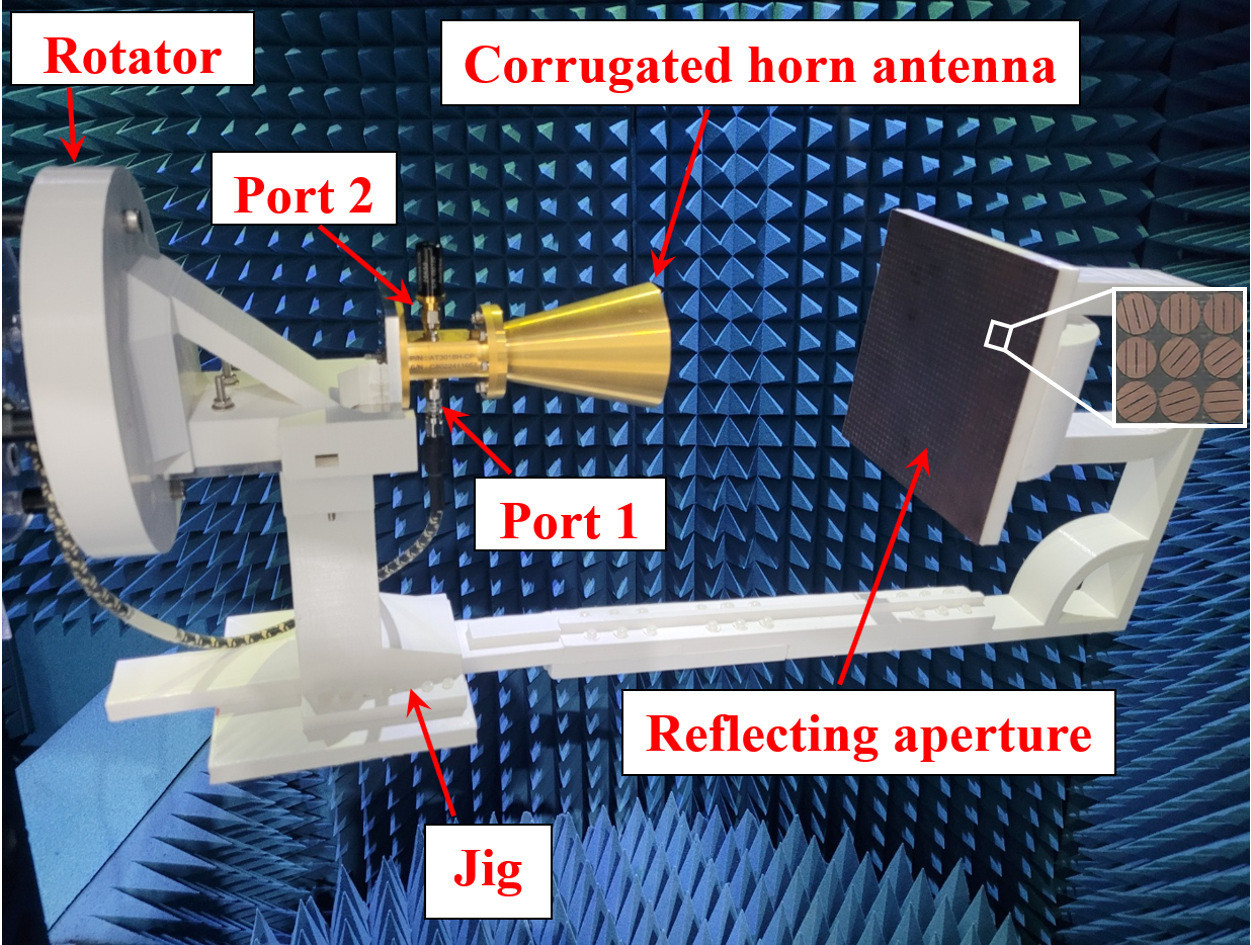
This paper presents a new design for a reflectarray antenna (RAA) that utilizes a variable rotation technique (VRT) and features a compact, single-layer substrate without the use of vias or air gaps. The proposed design achieves performance comparable to that of complex, multi-layer structures in terms of high gain, broad bandwidth, circular polarization, aperture efficiency, and low sidelobe and cross-polarization levels. Additionally, it offers the narrowest beamwidth among similar designs, making it a promising solution for point-to-point communication systems that require precise directionality. The resonance characteristics of the proposed RAA unit cell have been analyzed using characteristic mode analysis (CMA). Each element in the RAA is rotated to a specific angle, creating the required reflection phase distribution across the array and steering the main beam toward the desired direction. Furthermore, to enhance overall performance, the RAA is center-fed by a wideband, dual-circularly polarized corrugated horn antenna. The main beam direction is set at (θ0= –20°, ϕ0= 90°), with a focal ratio off/D= 1.1, which was selected to maximize aperture efficiency. A reflecting aperture measuring 143.43 mm × 143.43 mm, consisting of 37 × 37 elements, was fabricated and tested. The proposed RAA exhibits a measured 1.5-dB axial ratio bandwidth of 32% and a 3-dB gain bandwidth of 27.5%, with a measured peak gain of 28.6 dBic. The measured total aperture efficiency (TAE) reaches 40.5% at 25 GHz. The measured sidelobe and cross-polarization levels are less than –19.2 dB and –26.3 dB, respectively.
가변 회전 기법과 이중 원편파 주름 혼 급전을 쓴 단일층 K/Ka-대역 반사배열 안테나로, 매우 좁은 빔과 28.6 dBic 최대 이득, 40.5% 개구효율을 얻는다.
This paper presents a new design for a reflectarray antenna (RAA) that utilizes a variable rotation technique (VRT) and features a compact, single-layer substrate without the use of vias or air gaps. The proposed design achieves performance comparable to that of complex, multi-layer structures in terms of high gain, broad bandwidth, circular polarization, aperture efficiency, and low sidelobe and cross-polarization levels. Additionally, it offers the narrowest beamwidth among similar designs, making it a promising solution for point-to-point communication systems that require precise directionality. The resonance characteristics of the proposed RAA unit cell have been analyzed using characteristic mode analysis (CMA). Each element in the RAA is rotated to a specific angle, creating the required reflection phase distribution across the array and steering the main beam toward the desired direction. Furthermore, to enhance overall performance, the RAA is center-fed by a wideband, dual-circularly polarized corrugated horn antenna. The main beam direction is set at (θ0= –20°, ϕ0= 90°), with a focal ratio off/D= 1.1, which was selected to maximize aperture efficiency. A reflecting aperture measuring 143.43 mm × 143.43 mm, consisting of 37 × 37 elements, was fabricated and tested. The proposed RAA exhibits a measured 1.5-dB axial ratio bandwidth of 32% and a 3-dB gain bandwidth of 27.5%, with a measured peak gain of 28.6 dBic. The measured total aperture efficiency (TAE) reaches 40.5% at 25 GHz. The measured sidelobe and cross-polarization levels are less than –19.2 dB and –26.3 dB, respectively.
The abstract is reproduced from the published paper (doi:10.1109/access.2025.3606535) under its CC BY-NC-ND 4.0 licence.초록은 출판된 논문(doi:10.1109/access.2025.3606535)에서 CC BY-NC-ND 4.0 라이선스에 따라 옮겼습니다.