Seong-Hyeop Ahn, Chang-Hyun Jeong, and Wang-Sang Lee
Microwave and Optical Technology Letters, Vol. 65, No. 8, pp. 2158-2164
A 0.5 kW, 2.45 GHz microwave heater with two GaN amplifiers and active phase control steers its field to improve temperature uniformity by up to 70.7%.
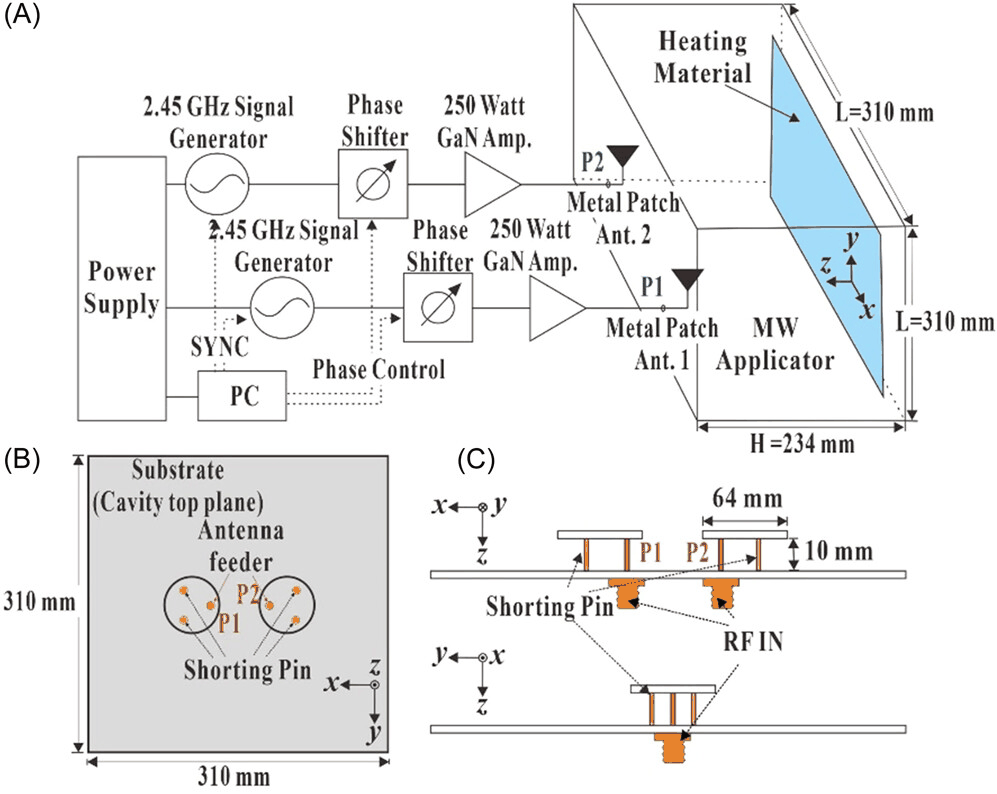
In this article, to improve the temperature uniformity of the microwave (MW) heating system, a 0.5-kW 2.45 GHz GaN (gallium nitride)-based MW heating system with active phase control is presented. The proposed system consists of two 2.45 GHz signal generators, two electrically controlled phase shifters, two 250 W GaN amplifiers, two metal patch antennas, and the MW applicator with a heating material. The controlled signal is radiated into the MW applicator through the antenna, and the radiation direction can be steered according to the input phase difference of the antenna. The electric field distribution and temperature uniformity at the different input phases were analyzed. Using four operating modes with a 90° phase difference between adjacent operating modes, the proposed heating system achieves a uniform temperature distribution. In comparison to the conventional heating system, the temperature uniformity was improved up to approximately 70.7%, and the system efficiency was approximately 56.7%.
GaN 증폭기 두 개와 능동 위상 제어로 전계 방향을 바꾸는 0.5 kW 2.45 GHz 마이크로파 가열 시스템으로, 온도 균일도를 최대 70.7% 높인다.
In this article, to improve the temperature uniformity of the microwave (MW) heating system, a 0.5-kW 2.45 GHz GaN (gallium nitride)-based MW heating system with active phase control is presented. The proposed system consists of two 2.45 GHz signal generators, two electrically controlled phase shifters, two 250 W GaN amplifiers, two metal patch antennas, and the MW applicator with a heating material. The controlled signal is radiated into the MW applicator through the antenna, and the radiation direction can be steered according to the input phase difference of the antenna. The electric field distribution and temperature uniformity at the different input phases were analyzed. Using four operating modes with a 90° phase difference between adjacent operating modes, the proposed heating system achieves a uniform temperature distribution. In comparison to the conventional heating system, the temperature uniformity was improved up to approximately 70.7%, and the system efficiency was approximately 56.7%.
The abstract is from the published paper (doi:10.1002/mop.33689).초록은 출판된 논문(doi:10.1002/mop.33689)에서 옮겼습니다.