

Min-Jae Kang, Hyoun-Joon Joo, In-Bok Kim, Hong-Sun Yoon, Jeong-Sub Kim, Sun-Woong Jang, and Wang-Sang Lee
2025 IEEE International Symposium on Antennas and Propagation and ITNC-USNC-URSI Radio Science Meeting(AP-S)
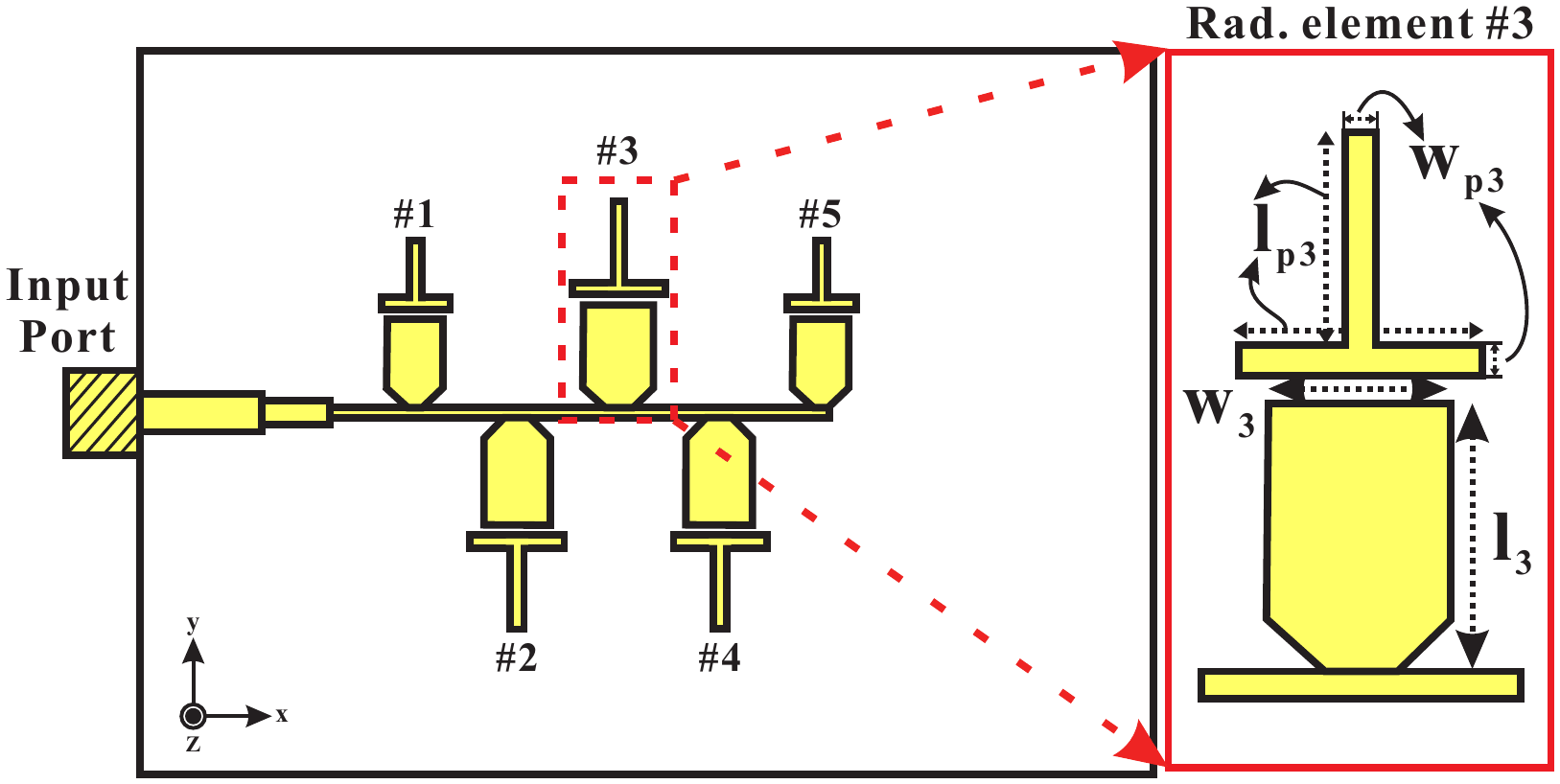
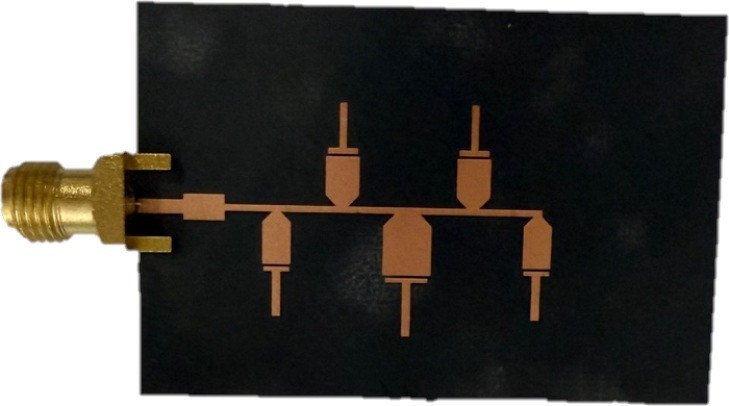
In this paper, a new combline antenna design for K-band millimeter-wave applications is presented, which introduces an integrated design approach incorporating multiple parasitic elements to address beam tilting issues and achieve wider beam coverage. Unlike conventional designs that use an even number of radiating elements, the proposed antenna employs an odd number of radiating elements to achieve miniaturization. Additionally, horizontal parasitic elements are used to adjust radiated power distribution, effectively resolving beam tilting issues. Furthermore, vertical parasitic elements based on array theory are utilized to expand the 3 dB beam coverage by approximately 42°. This design maximizes spatial efficiency while maintaining beam coverage expansion and high radiation efficiency. The proposed antenna maintains a simple structure and low-cost manufacturing process, while offering broader beam coverage and higher radiation efficiency compared to conventional designs. Furthermore, the proposed design is evaluated for its potential applications in automotive radar, short-range detection, and IoT networks.
In this paper, a new combline antenna design for K-band millimeter-wave applications is presented, which introduces an integrated design approach incorporating multiple parasitic elements to address beam tilting issues and achieve wider beam coverage. Unlike conventional designs that use an even number of radiating elements, the proposed antenna employs an odd number of radiating elements to achieve miniaturization. Additionally, horizontal parasitic elements are used to adjust radiated power distribution, effectively resolving beam tilting issues. Furthermore, vertical parasitic elements based on array theory are utilized to expand the 3 dB beam coverage by approximately 42°. This design maximizes spatial efficiency while maintaining beam coverage expansion and high radiation efficiency. The proposed antenna maintains a simple structure and low-cost manufacturing process, while offering broader beam coverage and higher radiation efficiency compared to conventional designs. Furthermore, the proposed design is evaluated for its potential applications in automotive radar, short-range detection, and IoT networks.