

Dong-Geun Seo, Chang-Hyun Jeong, Yu-Seong Choi, Jeong-Su Park, Ye-Yeong Jeong, and Wang-Sang Lee
2019 IEEE International Symposium on Antennas and Propagation and USNC-URSI Radio Science Meeting
Adding parasitic elements to a two-dipole array widens its beam coverage by about 156% at 5.09 GHz for UAV-to-everything links.
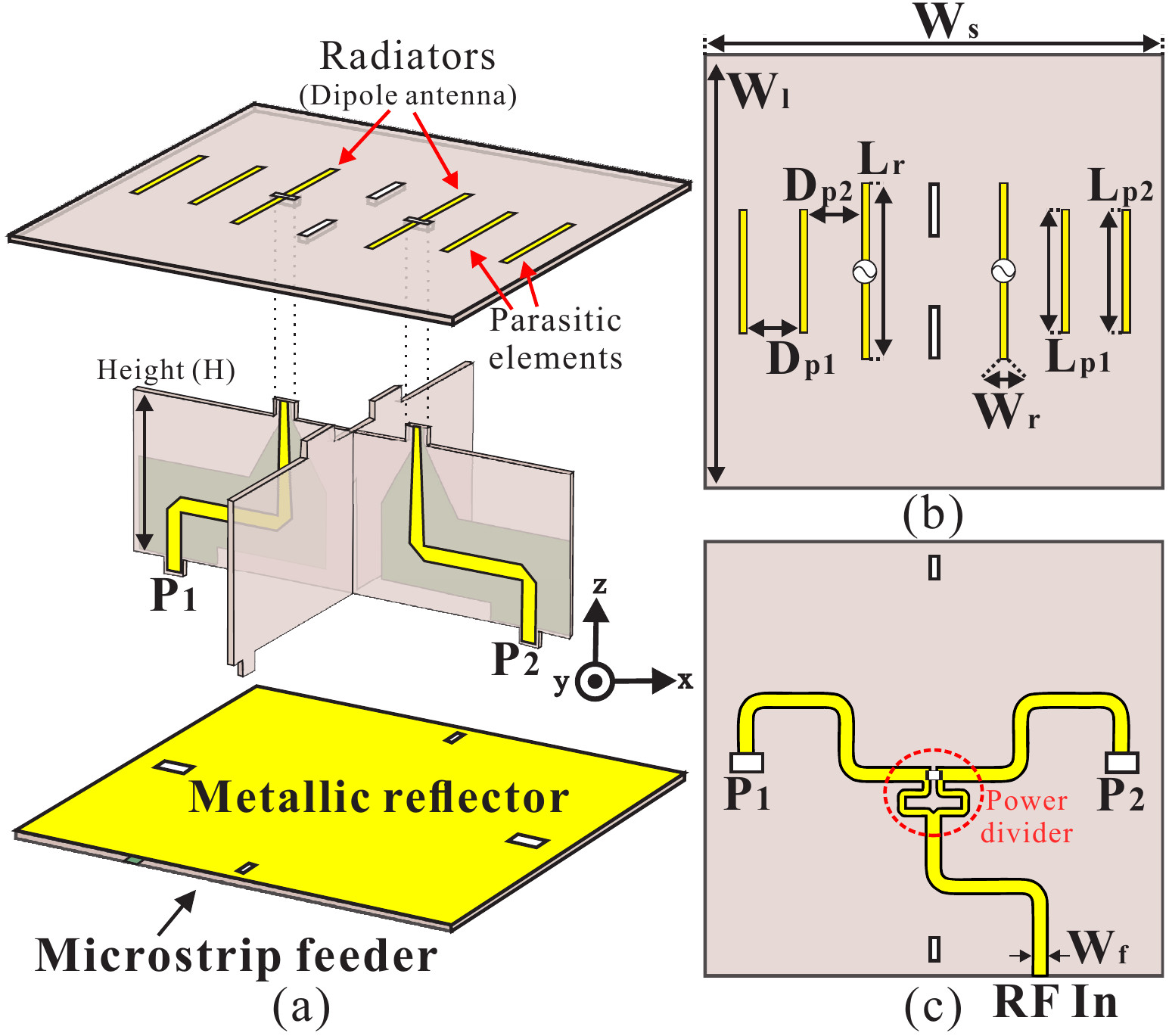
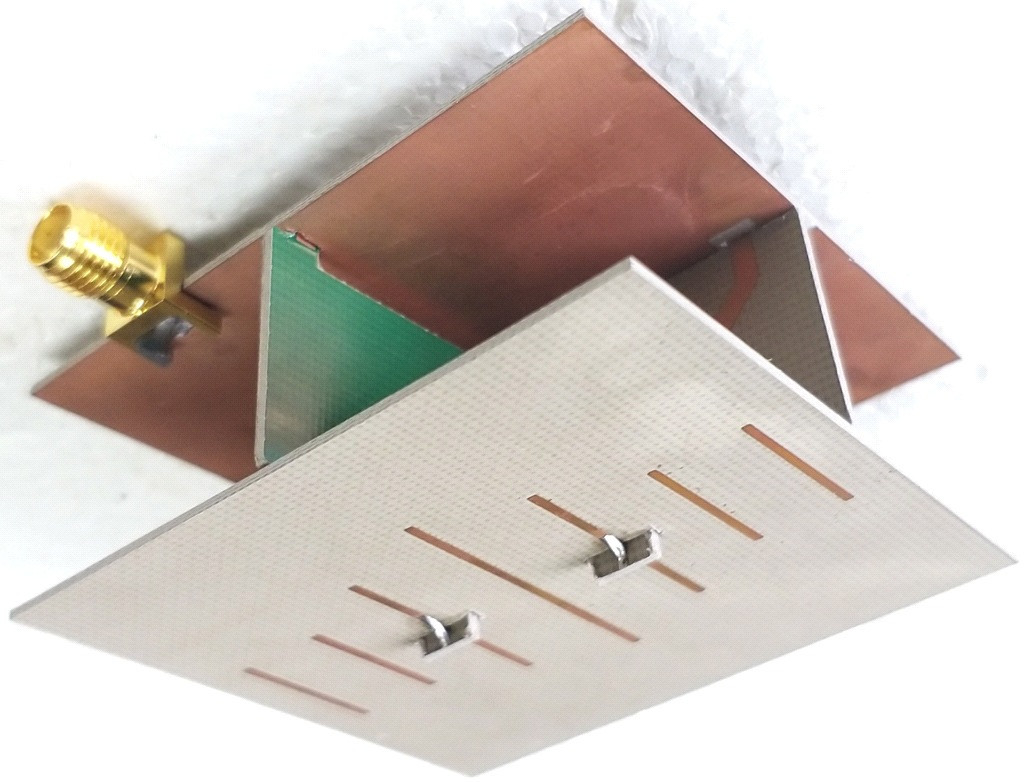
To apply the unmanned aerial vehicle (UAV) to everything (U2X) communication such as UAV and infrastructure, wide beam coverage dipole antenna array with parasitic elements is presented in this paper. Based on the linear array antenna theory using dipole antennas, it consists of two dipole antennas with parasitic elements. The proposed antenna is composed of a radiator in top substrate, two supports with the balun, and metallic reflector with a feeder. Two dipole antennas made up of broadside beam. Moreover, added parasitic elements improve the beam coverage. Simulated 10-dB impedance bandwidth is approximately 14% and the center frequency is 5.09 GHz. The peak gain, total efficiency, and half power beamwidth (HPBW) are 5 dBi, 84%, and 161°, respectively. Compared to dipole antenna array without parasitic elements (reference antenna), the proposed antenna improved approximately 156% of beam coverage.
다이폴 두 개 배열에 기생소자를 더해 5.09 GHz에서 빔 커버리지를 약 156% 넓힌 무인기 통신용 안테나이다.
To apply the unmanned aerial vehicle (UAV) to everything (U2X) communication such as UAV and infrastructure, wide beam coverage dipole antenna array with parasitic elements is presented in this paper. Based on the linear array antenna theory using dipole antennas, it consists of two dipole antennas with parasitic elements. The proposed antenna is composed of a radiator in top substrate, two supports with the balun, and metallic reflector with a feeder. Two dipole antennas made up of broadside beam. Moreover, added parasitic elements improve the beam coverage. Simulated 10-dB impedance bandwidth is approximately 14% and the center frequency is 5.09 GHz. The peak gain, total efficiency, and half power beamwidth (HPBW) are 5 dBi, 84%, and 161°, respectively. Compared to dipole antenna array without parasitic elements (reference antenna), the proposed antenna improved approximately 156% of beam coverage.
The abstract is from the published paper (doi:10.1109/apusncursinrsm.2019.8888747).초록은 출판된 논문(doi:10.1109/apusncursinrsm.2019.8888747)에서 옮겼습니다.